In today’s dynamic agriculture and tech landscape of Pakistan, knowing the exact size of your greenhouse and maintaining the correct climate inside it can make or break crop yield. Using a greenhouse area and temperature calculator is no longer a luxury — it’s a key tool for precision farming, whether you are operating in Sindh, Punjab, or the mountainous regions of Khyber Pakhtunkhwa. By adopting the right digital tools, farms can move from guesswork to data‑driven planning, align with national youth‑training programmes, and even link agriculture with innovations from Pakistan’s top tech innovation hub.
Why Knowing Greenhouse Floor Area Matters
Quick Answer: Calculating the floor and surface area of a greenhouse ensures you design the structure correctly, allocate resources efficiently, and avoid under‑ or over‑investing.
Area affects how much crop you can plant, how much ventilation or cooling you need, and what materials you use.
For example, a gable‑roof structure might require a calculation like:
Surface Area ≈ End‑gables + Roof Area + Side Walls. vcalc.com+1
In Pakistan’s context where climatic extremes are common (very hot summers in Bahawalpur for instance), knowing the area helps plan for insulation, shading, and airflow.
It also links to cost control: fewer surprises in construction, fewer wasted materials, better yield management.


Understanding Greenhouse Area and Temperature Relationships
Quick Answer: The size of the greenhouse (area) directly impacts temperature control needs; larger area often means more volume, more heat retention, longer cooling or heating cycles.
Using an area calculator helps you understand how much heat may build up during the day or how much you’ll need to cool at night.
A credible tool that models climate inside a greenhouse uses inputs like structure dimensions + local climate data. hortinergy.com+1
For example: in Lahore’s summer midday, a 100 m² poly‑tunnel will accumulate more heat than a 50 m² shaded structure unless ventilation is sized accordingly.
Thus, combining area calculation with temperature modelling leads to better crop growth outcomes and energy efficiency.
Step‑by‑Step How to Use a Greenhouse Area and Temperature Calculator
Quick Answer: Follow a clear sequence: measure, input, model, interpret.
Step 1: Measure structure
Length (L) and width (W) of the footprint.
Interior height or eaves height if applicable.
Step 2: Input into the area calculator
Use tools that allow for gable, lean‑to, or arched greenhouse shapes. gothicarchgreenhouses.com+1
Step 3: Combine with climate inputs
Local outside temperature, desired inside temperature, insulation factor.
Some calculators give you heat‑loss or ventilation needs too. Hartley Botanic+1
Step 4: Interpret results
Establish how much area you’ve got vs how many plants you’ll grow.
Calculate how much cooling/heating will be required for your region (e.g., in Sindh vs. Azad Kashmir).
Step 5: Adjust your design or plan accordingly
Maybe reduce area or change orientation, add shading, increase ventilation.
Decide if local youth training programmes (e.g., in Punjab’s agricultural universities) can help in implementing the design.
Choosing the Right Digital Tool for Your Greenhouse
Quick Answer: Select a tool that suits your greenhouse type, climate zones of Pakistan, ease of use, and support for temperature modelling.
Look for calculators that allow dim‑type selection (arched, gabled, lean‑to) and localised inputs. gothicarchgreenhouses.com+1
Prioritise user‑friendly interfaces that local extension services in Pakistan can adopt.
Consider platforms that also model energy, lighting, ventilation: these are increasingly being used internationally. hortinergy.com
One example you should use is the online platform at Needs Calculator — you can easily use the agriculture greenhouse module at https://needscalculator.com/agriculture-greenhouse with practical inputs.
For ongoing daily usage (and multiple tools beyond just greenhouse sizing), you can also visit Needs Calculator for daily tools at https://needscalculator.com/.
Regional Case Example — Greenhouse Planning in Punjab, Pakistan
Quick Answer: In Punjab, where irrigation is well‑developed and govt programmes support youth in agritech, proper area calculation is essential to scale modern greenhouses.
The Government of Punjab’s youth‑tech initiative provides training in smart farming, including greenhouse modules.
Suppose a youth‑run small farm near Multan wants to build a 150 m² greenhouse. By using the calculator, they can determine the internal volume, surface area, and required ventilation/insulation for a summer high of ~45 °C.
This planning leads to lower cooling cost, higher crop quality (e.g., tomatoes, cucumbers) and better market value.
Linking tech development initiatives like those at Punjab’s agricultural universities strengthens trust in precision‑tools.
Also, aligning with the national vision of digital agriculture positions Pakistan as a competitive agritechnology hub.
Benefits for Tech & Innovation Hubs in Pakistan
Quick Answer: Greenhouse calculators bridge agriculture and tech innovation—ideal for ecosystems such as Pakistan’s top tech innovation hub.
For example, consider the role of the Dhanote IT Park in advancing agri‑tech startups. Pakistan’s top tech innovation hub provides infrastructure, mentorship, and funding for digital agriculture.
A startup can embed the greenhouse area calculator into a larger SaaS platform offering crop monitoring, IoT sensors, climate modelling.
By using accurate area & temperature modelling, these startups reduce risk, improve investor confidence, and link with national smart‑farm programmes.
This interlinking of tools (area calculator → climate modelling → IoT → data analytics) is exactly what future‑ready farms in Punjab, Sindh and Khyber Pakhtunkhwa need to adopt.
Common Pitfalls and How to Avoid Them
Quick Answer: Common mistakes include inaccurate measurements, ignoring climate variables, and misinterpreting output results.
Mistake 1: Using only length × width without accounting for height or roof shape → leads to under‑estimating ventilation or insulation needs.
Mistake 2: Ignoring regional climate differences — Pakistan has wide variations in temperature and humidity; a one‑size calculator may not suffice unless region‑adjusted.
Mistake 3: Failing to interpret results into actionable design — you learn area, but if you don’t act (e.g., adding fans or shade), the benefit is lost.
Solution: Always validate your inputs, cross‑check with local extension/pilot farms, and use the calculator as a starting point — not the final word.
Integrating Youth Training & Government‑backed Programmes
Quick Answer: Leveraging government and youth‑training initiatives amplifies the value of the tool and ensures sustained adoption.
Pakistan’s Ministry of National Food Security & Research has youth‑agriculture training programmes that include greenhouse operations and climate control.
If young agripreneurs use a greenhouse calculator early, they build a habit of data‑driven farming, aligning with national smart‑agriculture policy.
Tech parks like the Dhanote IT Park act as incubators for agritech startups; embedding calculators, IoT sensors, dashboards and localised training builds ecosystem trust.
Example: A training workshop in Lahore can teach youth how to feed their greenhouse dimensions into the tool, simulate hot‑season temperature build‑up, and plan accordingly.
How to Interpret Results and Make Design Decisions
Quick Answer: Use your calculator results to make real‑world design decisions on plant spacing, climate control systems and cost‑allocation.
From the area result you can determine how many crop rows you’ll fit, how much bench space you need, and how to layout irrigation lines.
Temperature modelling shows you when active cooling or shading will be necessary — thus affecting capital cost.
For instance: if the tool says at 150 m² you’ll need 40 kWh/day cooling in June in Multan, then you may decide to reduce area or add high‑efficiency fans.
This ultimately turns into a business plan for the greenhouse venture: design size → climate control → crop choice → revenue forecast.
Real‑World Example – Smallholder Greenhouse in Sindh
Quick Answer: A real smallholder example in Sindh demonstrates how area + temperature calculation leads to higher efficiency and yields.
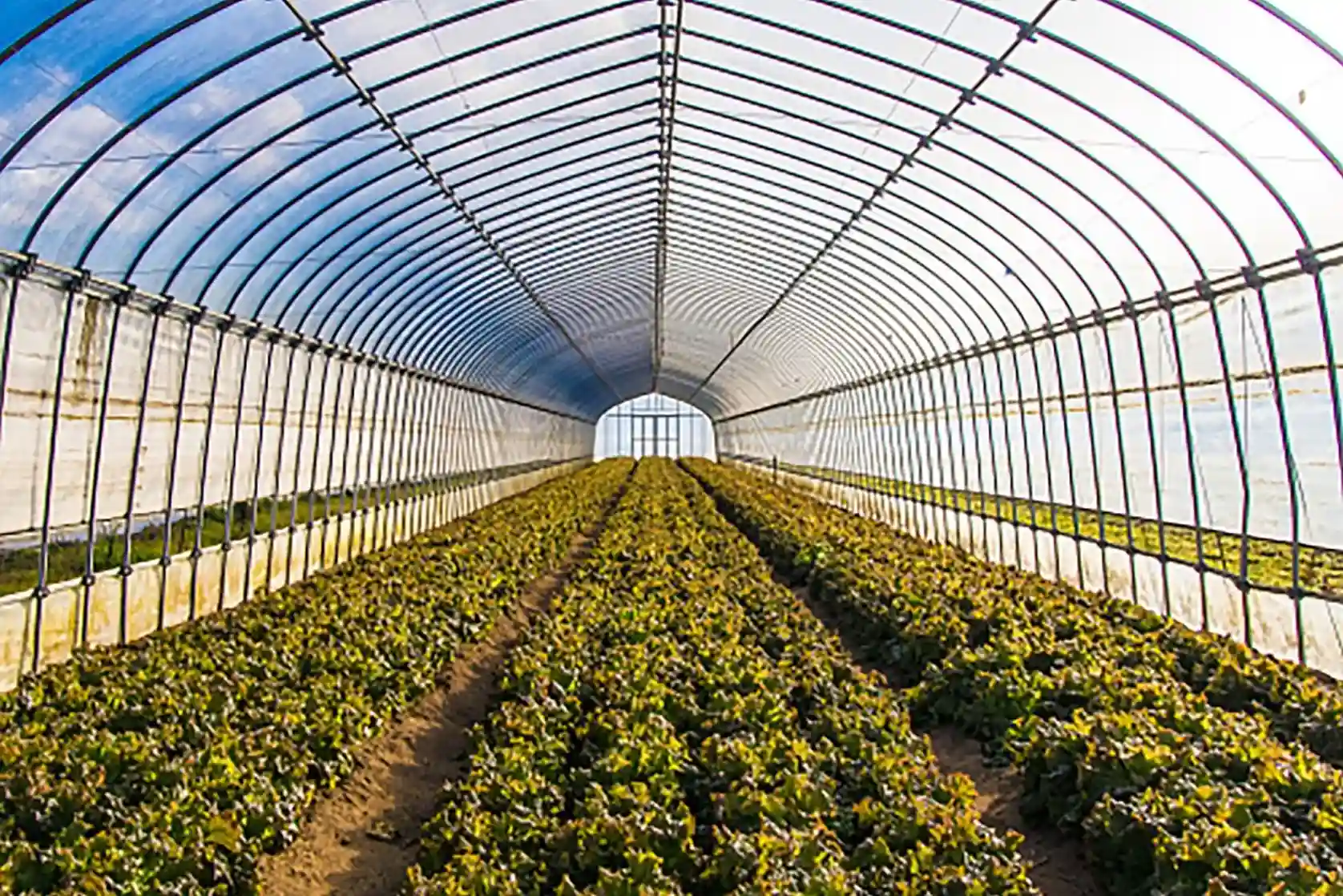
A small farm near Hyderabad built a 120 m² tunnel greenhouse. Using a calculator, the farmer input his structure dimensions and local climate data and discovered that natural ventilation alone would not suffice during peak May–June heat.
As a result, he added retractable shade cloth (30%), an exhaust fan system, and built benches spaced at 0.8 m rather than 1.0 m.
The result: Improved tomato yield by ~20% vs surrounding open‑field growers, reduced heat‑induced stress. This aligns with global research indicating that controlled environment agriculture pays off when area & climate are well‑designed.
It highlights how calculator → design change → better outcome chain works.
FAQs
Q1: What size greenhouse area should I aim for in Pakistan to start with?
A1: There’s no one‑size fits all. A good starting size could be 50‑150 m² for small farms. Use the area calculator to input your dimensions and local climate specifics before committing.
Q2: Does the calculator also model temperature and airflow?
A2: Some advanced calculators do model internal climate (heating/cooling, ventilation). The basics calculate area, but you’ll want a version that includes climate if you’re serious. hortinergy.com+1
Q3: How accurate are these online calculators?
A3: They provide good estimates, but local variables (wind speed, insulation materials, orientation) may affect results. Use them as guides and validate against real measurements or pilot builds.
Q4: Can I use the calculator for different greenhouse shapes (arched, lean‑to, gable)?
A4: Yes — many calculators support different roof shapes and structures. For example, one site lists separate entries for Quonset & High Tunnel, lean‑to, etc. gothicarchgreenhouses.com
Q5: Is localization (for Pakistan’s climate zones) important?
A5: Very important — Pakistan spans hot plains, arid zones, and cooler highlands. Always feed local temperature/humidity data for meaningful output.
Q6: Are these tools free for farmers and start‑ups?
A6: Many calculators are free or freemium. For example, the agriculture greenhouse module at Needs Calculator is accessible online and suitable for small‑scale use.
Q7: How does this tie into tech hubs or innovation parks in Pakistan?
A7: Tools like a greenhouse area calculator become modules in agritech platforms developed or incubated by hubs like Pakistan’s top tech innovation hub. This brings precision farming and digital innovation together.
Final Thought
As someone working at the intersection of technology and agriculture here in Pakistan, I’ve seen first‑hand how traditional greenhouse builds often underperform simply because the sizing and climate control were done by rough guesswork. By embracing a tool like the greenhouse area and temperature calculator, farmers and agritech start‑ups in Pakistan can leapfrog ahead. And when this precision is combined with supportive frameworks from our government’s youth‑training programmes and ecosystem enablers such as Pakistan’s tech innovation hub, we create not just better farms — we build smarter, resilient agri‑enterprises. For anyone in Lahore, Multan, Karachi or Gilgit, plug in your dimensions today, model the climate, experiment and iterate. The data‑driven path is the future.