
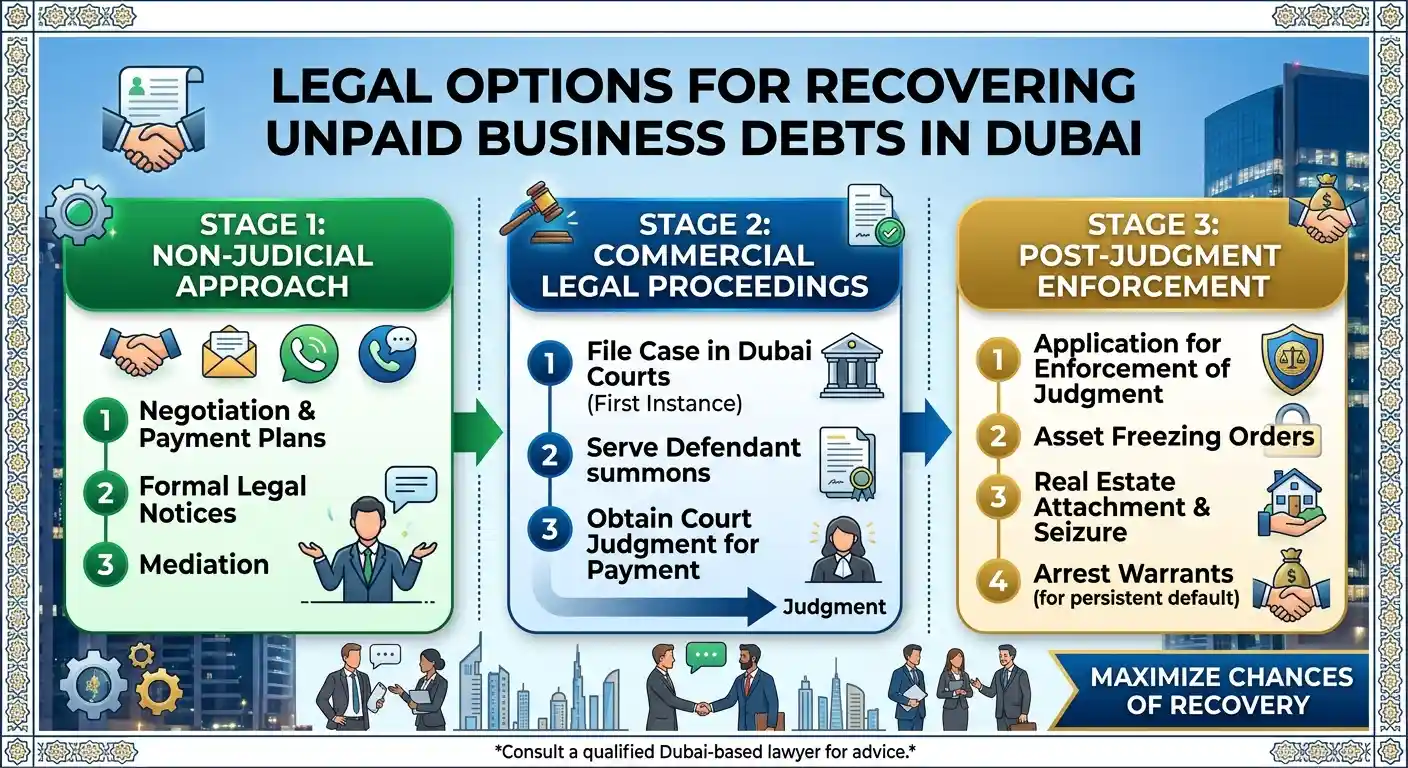
Recovering unpaid business debts can be challenging when customers, suppliers, or commercial partners fail to meet their financial obligations. For companies operating in the UAE, Debt Collection Dubai services can help identify appropriate recovery strategies, organize supporting evidence, negotiate payment arrangements, and assess whether formal legal action is necessary.
Dubai’s business environment involves local companies, international investors, service providers, and commercial trading relationships. When a payment dispute arises, creditors need to understand their legal options before deciding how to proceed. Taking timely action can help protect cash flow, preserve evidence, and improve the chances of recovering outstanding amounts.
- Can a Business Recover an Unpaid Debt Through Negotiation?
Negotiation is often a practical first step when a customer or business partner has failed to pay an invoice. Some debtors experience temporary financial difficulties, overlook payment deadlines, or dispute particular charges rather than refusing to pay the entire amount.
A creditor can begin by reviewing the agreement, calculating the outstanding balance, and contacting the debtor with a clear written payment request. The communication should identify the relevant invoices, payment deadlines, and amount due.
If the debtor acknowledges the debt but cannot pay immediately, the parties may consider an installment arrangement or another settlement. Any agreement should specify payment dates, amounts, and the consequences of missed payments.
Professional Debt Collection Dubai assistance can help businesses approach negotiations systematically while maintaining appropriate commercial communication. However, a settlement should be evaluated carefully to ensure that its terms protect the creditor’s interests.


- When Should a Creditor Send a Formal Payment Demand?
A formal payment demand may be appropriate when informal reminders have failed or the debtor has not provided a satisfactory explanation for the delay.
The demand should clearly identify the creditor, the debtor, the contractual relationship, the outstanding amount, and the invoices or obligations involved. It should also state the payment requested and provide a reasonable deadline where appropriate.
Before sending a formal notice, the creditor should review the contract for any required notification procedure, dispute-resolution clause, or contractual deadline. Certain claims may be subject to specific legal or procedural requirements.
A lawyer can help prepare a demand that accurately describes the claim and avoids unsupported allegations. A formal demand does not guarantee payment, but it can create a useful written record of the creditor’s recovery efforts.
- Can a Creditor File a Court Case for an Unpaid Debt?
A creditor may be able to pursue legal proceedings when an amount remains unpaid and the claim has an appropriate legal basis. The suitable procedure depends on the nature of the debt, the available evidence, the parties involved, and the court or forum with jurisdiction.
Before filing a claim, the creditor should establish the amount owed and gather relevant records, such as contracts, invoices, delivery documents, account statements, and correspondence acknowledging the obligation.
The creditor should also assess potential costs, the possibility of a counterclaim, and whether the debtor has a legitimate defence. A disputed invoice may require a different approach from an undisputed contractual amount.
Legal advice can help determine whether court proceedings are appropriate and explain the documents and procedural steps that may be required.
- What Is a Payment Order, and When Might It Be Relevant?
Under certain circumstances, UAE legal procedures may provide a payment-order route for claims that satisfy the applicable statutory conditions. This can be relevant where a creditor seeks recovery of a qualifying monetary debt supported by the required documentation.
However, a payment order is not automatically available for every unpaid invoice or commercial disagreement. Eligibility depends on the legal requirements, the nature of the obligation, the supporting evidence, and the applicable procedure.
A creditor should not assume that simply issuing an invoice is sufficient. The documents must establish the claim in the form required by the relevant legal process.
A qualified lawyer can assess whether this route is suitable or whether an ordinary court claim or another dispute-resolution mechanism would be more appropriate.
- Can a Creditor Recover a Debt Through Arbitration?
Some commercial contracts contain arbitration clauses requiring disputes to be resolved through arbitration rather than ordinary court proceedings, subject to applicable law.
Where a valid arbitration agreement applies, a creditor may need to follow the agreed arbitration procedure before seeking a final determination of the debt. The contract may specify the arbitration institution, seat, language, or procedural rules.
Arbitration can be suitable for certain commercial disputes, particularly where the parties have agreed to that process. Nevertheless, it may involve significant costs, and the appropriate approach depends on the amount in dispute and the contractual arrangements.
If an arbitration award is obtained, further legal steps may be required to recognize or enforce it, depending on the circumstances.
Before beginning recovery proceedings, businesses should review their contracts carefully to determine whether arbitration or another agreed dispute-resolution mechanism applies.
- What Evidence Is Important in a Business Debt Claim?
Reliable documentation is central to successful debt recovery. The creditor should be able to explain why the money is owed, how the amount was calculated, and whether the payment obligation has become due.
Useful evidence may include:
- Signed contracts and purchase orders.
- Tax invoices and account statements.
- Delivery notes or proof of completed services.
- Correspondence concerning payment terms.
- Written acknowledgements of the outstanding balance.
- Records of partial payments or agreed deductions.
- Relevant company records identifying the contracting parties.
Where the debtor disputes the debt, supporting evidence may also be needed to address complaints about defective goods, incomplete work, disputed charges, or contractual performance.
Businesses should preserve original documents and maintain consistent accounting records. They should also avoid changing or removing relevant communications after a dispute arises.
- What Happens if the Debtor Refuses to Pay After a Judgment?
Obtaining a court judgment does not necessarily mean that the creditor will receive payment immediately. If the debtor still fails to pay, the creditor may need to initiate the applicable enforcement procedure.
Depending on the circumstances and legal requirements, enforcement may involve identifying assets or funds that can lawfully be reached through the relevant process. The available measures depend on the applicable law, the court’s authority, and the debtor’s financial circumstances.
Creditors should avoid attempting to seize property, access accounts, or pressure debtors through unauthorized methods. Enforcement must be pursued through the legally prescribed channels.
Before investing additional time and money, a creditor may wish to assess whether the debtor has identifiable assets and whether further enforcement action is commercially reasonable.
- Can Businesses Recover Debts From International Customers?
International debt recovery can involve additional legal and practical challenges. A Dubai-based business may be owed money by a customer located in another emirate or a different country.
The creditor may need to determine which law governs the contract, which court or tribunal has jurisdiction, and where legal proceedings or enforcement can take place.
Relevant factors include the contract’s dispute-resolution provisions, the debtor’s location, the location of assets, and whether a foreign judgment or arbitration award can be recognized and enforced in the relevant jurisdiction.
Cross-border recovery may also involve translation, service of documents, and local legal representation.
Businesses should obtain advice before commencing proceedings because pursuing a claim in the wrong forum can increase costs and delay recovery.
- Are There Time Limits for Recovering Business Debts in Dubai?
Debt claims may be subject to statutory limitation periods or other deadlines. The applicable period depends on the legal relationship, the nature of the claim, and the rules governing the relevant proceedings.
Businesses should not assume that an unpaid invoice can be pursued indefinitely. Delays may affect the available remedies, the evidence supporting the claim, or the ability to obtain a legal determination.
The date on which a payment became due, subsequent acknowledgements, partial payments, and other relevant events may affect the legal analysis, depending on the applicable rules.
A lawyer can review the circumstances and identify deadlines that may apply. Creditors should seek advice promptly when a debt remains unpaid for an extended period.
- How Can Debt Collection Dubai Services Support Legal Recovery?
Debt Collection Dubai services can help businesses organize their recovery efforts and determine when a matter may require legal intervention.
Depending on the provider’s qualifications and the agreed scope of work, assistance may include reviewing the debt documentation, preparing payment demands, negotiating settlements, coordinating with legal professionals, and explaining possible recovery procedures.
Businesses should ask about the provider’s experience, fee structure, communication practices, and whether court representation is included or arranged separately.
No responsible provider should guarantee that every debt will be recovered. The outcome depends on the evidence, applicable law, the debtor’s financial position, and the available legal remedies.
Conclusion
Businesses in Dubai have several potential options for recovering unpaid debts, including negotiation, formal payment demands, court proceedings, qualifying payment-order procedures, and arbitration where a valid agreement applies.
The right approach depends on the amount owed, the supporting evidence, the contractual terms, and the debtor’s response. Reviewing these factors before taking action can help creditors avoid unnecessary costs and choose a suitable recovery strategy.
By maintaining accurate records, responding promptly to overdue payments, and obtaining qualified legal advice, when necessary, businesses can protect their financial interests and manage commercial risks more effectively.
Disclaimer: This article provides general information and does not constitute legal or financial advice. Available remedies, limitation periods, and procedural requirements depend on the applicable UAE laws and the specific circumstances of each debt claim.