
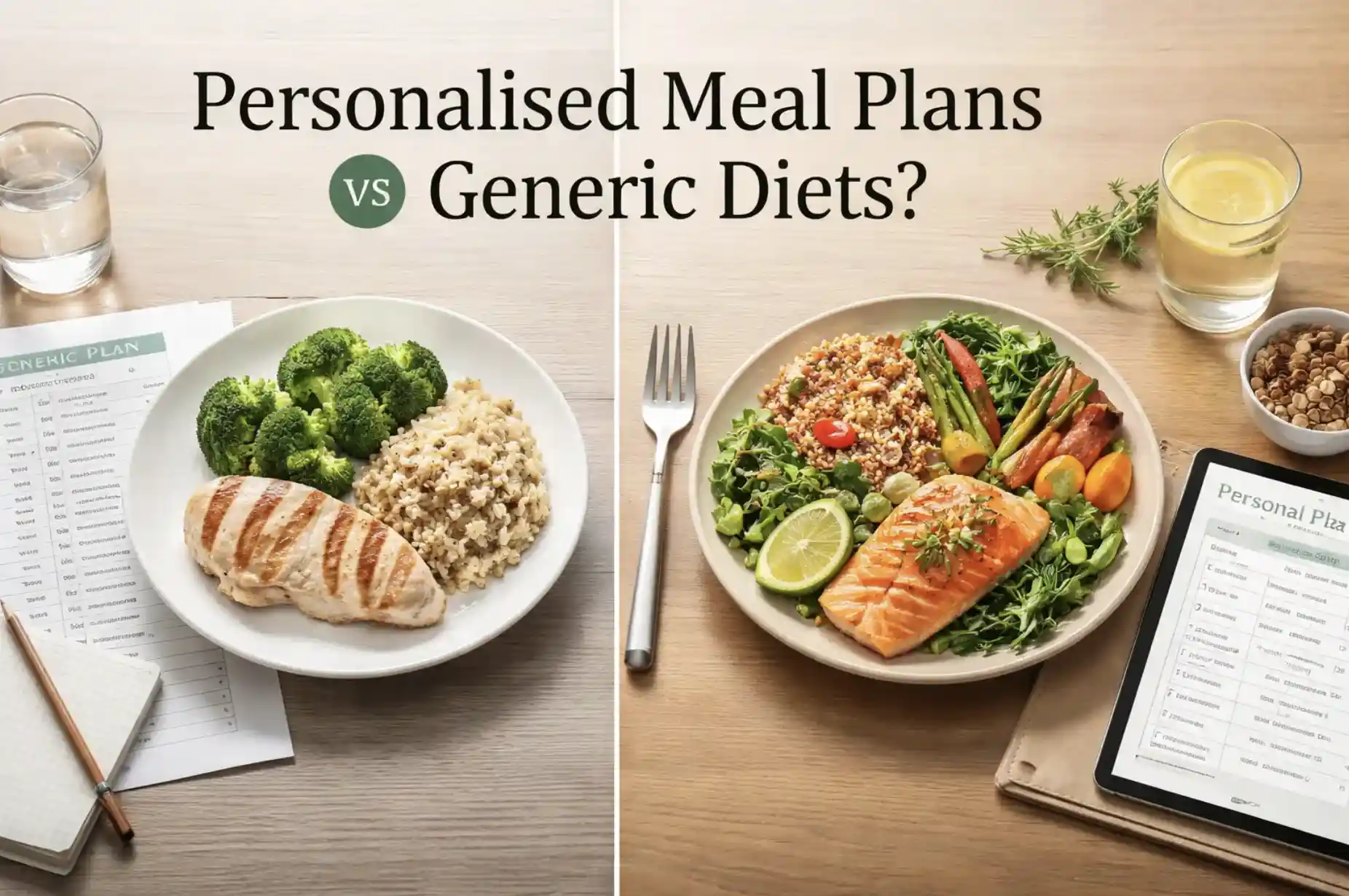
Most people don’t fail diets. Diets fail people.
Scroll through social media and you’ll find hundreds of “proven” diet templates. Keto. Low-carb. Detox. Intermittent fasting. Each promising results for everyone.
This is why health-conscious individuals are increasingly choosing customised nutrition over copy-paste diets, particularly in fast-paced, climate-specific regions like the UAE.
In this context, effective meal plans in Dubai must go beyond calorie counts and reflect local lifestyle realities. Which is why UAE-based meal plan providers, including Delicut, structure their programs around portion control, cuisine variety, and delivery consistency rather than relying on generic global diet templates.
Top 7 reasons why personalised meal plans outperform generic diets
1. Your body is not an average statistic
Generic diets are built around population averages.
Your metabolism isn’t.


Your calorie needs depend on:
- Basal metabolic rate
- Muscle mass
- Hormonal balance
- Activity levels
- Stress and sleep patterns
Two people can weigh the same and need completely different nutritional strategies.
Research consistently shows that personalised dietary interventions improve adherence compared to standardised plans. And adherence, not intensity, is the biggest predictor of long-term success.
When a plan reflects your actual energy output and biology, it works with your body instead of fighting it.
2. Sustainability beats restriction
The number one reason people quit diets?
They’re not sustainable.
Generic diets often:
- Remove entire food groups
- Create aggressive calorie deficits
- Ignore cultural eating patterns
- Overlook ingredient availability
They might work short term.
But they rarely survive social dinners, travel, office stress, or weekend brunch.
Personalised meal planning adapts to your schedule instead of forcing you to adapt to it.
The result?
- Higher compliance
- Fewer relapses
- Consistent progress
3. Fat loss without muscle loss
Weight loss isn’t just about reducing calories. It’s about preserving lean mass while reducing fat.
Poorly structured generic diets often reduce both.
That slows metabolism and makes recovery more likely.
Personalised meal plans typically:
- Optimise protein intake
- Balance carbohydrates based on activity
- Prevent extreme metabolic slowdown
- Support recovery and performance
Studies in structured weight management programs show better body composition outcomes when nutrition is tailored rather than self-prescribed.
That means improved fat loss efficiency and better long-term metabolic health.
4. Blood sugar and hormonal response vary by individual
Two people can eat the exact same meal and experience completely different blood sugar spikes.
Precision nutrition research confirms that glycemic responses are highly individual.
Generic plans don’t account for:
- Insulin sensitivity
- PCOS
- Thyroid conditions
- Stress-driven cortisol patterns
- Digestive tolerance
When meals align with your metabolic response, something interesting happens:
Cravings reduce.
Energy stabilises.
Mood improves.
And discipline becomes less necessary.
5. Local context matters more than most realise
Geography changes nutrition more than most realise.
In the UAE:
- Heat affects hydration and electrolyte needs
- Work culture shapes meal timing
- Social dining is frequent
- Cuisine diversity is wide
A meal plan built for a Western office routine may not translate well into a Gulf lifestyle.
Effective nutrition in Dubai needs to consider:
- High temperatures
- Delivery consistency
- Balanced, culturally familiar dishes
- Flexible portion structures
When a plan fits the environment, it becomes easier to sustain.
6. Personalisation breaks the “start-stop” cycle
Generic dieting often leads to:
Strict weekdays. Cheat weekends. Guilt. Restart.
Personalised planning shifts focus toward:
- Structured flexibility
- Realistic portions
- Long-term habit formation
- Gradual adjustments
It replaces extremes with stability.
And stable systems outperform short bursts of discipline.
7. Dynamic adjustment vs static templates
Most generic diets are static documents. They don’t evolve.
Personalised nutrition adapts:
- When weight plateaus
- When activity levels change
- When goals shift
- When life gets busy
That feedback loop is what creates measurable improvement over time.
Without adjustment, even a good plan eventually stops working.
Conclusion: The real difference
Generic diets aim for mass appeal. Personalised meal plans aim for precision.
When nutrition reflects your biology, environment, schedule, and goals, results become sustainable instead of temporary. That’s why tailored nutrition consistently outperforms one-size-fits-all dieting.