

Healthcare
4 min read
Choosing the Best Fertility Clinic and Doctor in Al Khobar: A Complete Guide for Couples
Beginning a journey to parenthood, many couples in the Eastern Province first seek careful support. While not every option…
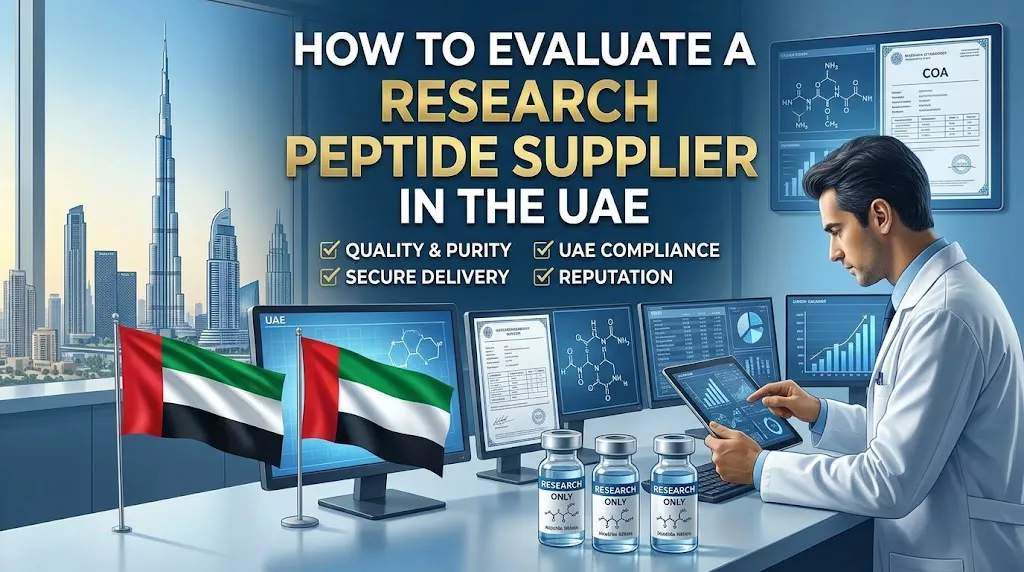
Choosing a research peptide supplier in the United Arab Emirates (UAE) requires careful consideration of product identification, analytical documentation, batch traceability, business transparency, and storage information.
For laboratories and research organizations, a supplier’s website or product catalogue provides only an initial overview. More detailed evaluation is necessary to understand what documentation is available and whether the information can be independently verified.
A professional supplier should be able to explain the origin of its product information, identify the relevant research material, and clarify the scope of any published laboratory reports.
This guide provides a practical framework for evaluating research peptide suppliers in the UAE, with particular attention to documentation verification and responsible procurement.
Begin by establishing whether the supplier has a clearly identifiable business presence.
A professional supplier should provide consistent business information through its official website and communication channels.
Consider checking:
Researchers should independently verify important business details where possible.
For example, if payment instructions arrive through a new messaging account or an unfamiliar email address, confirm the request using an established official contact channel.
A professional-looking website alone does not establish the legitimacy of a business. Business identity and product documentation should be evaluated separately.
Product identification is another important part of supplier evaluation.
A product listing should clearly identify the material being described rather than relying on broad marketing terminology.
Depending on the product, relevant information may include:
Researchers should pay attention to differences between product strengths and formats.
For example, a supplier may associate a published laboratory report with multiple product listings. However, this association does not necessarily mean that every listed strength or format was independently tested.
The distinction between an exact sample match and a supplier-mapped product association should be clearly documented.
A supplier’s documentation practices can reveal how carefully it manages product information.
Ask whether the supplier provides:
When examining a COA, look for the issuing laboratory, report reference, sample description, testing date, analytical methods, and reported findings.
A document should be assessed according to the information it actually contains.
For instance, an HPLC report should not automatically be interpreted as proof of molecular identity, sterility, or every other characteristic of a research sample.
Likewise, a report without sufficient identifying information may be difficult to connect to a particular product.
Independent laboratory documentation can provide additional information when evaluating a research material supplier.
However, researchers should distinguish between a genuine laboratory report and a supplier-created summary.
A useful review process includes:
Step 1: Obtain the Complete Report
Request the complete laboratory document rather than relying on a cropped image or promotional graphic.
Step 2: Identify the Issuing Laboratory
Check the laboratory name, report reference, and available identification details.
Step 3: Review Sample Identification
Examine the sample name, sample reference, and any batch information included in the report.
Step 4: Examine the Analytical Scope
Identify which analytical methods were performed and what properties were examined.
Step 5: Compare the Available Information
Compare the report with the supplier’s product listing and associated documentation.
If the supplier associates one tested sample with several strengths or formats, that relationship should be clearly identified as supplier mapping unless each format has its own supporting test record.
These steps help laboratories understand what the documentation establishes and where further clarification may be necessary.
This distinction is particularly important when evaluating suppliers.
Laboratory testing applies to the sample submitted for analysis.
A published report should not automatically be interpreted as evidence for every product sold under the same name.
For example, a supplier may publish a report for one particular product strength but associate it with additional strengths or packaging formats.
There are two different situations:
Exact Sample Match
The published product corresponds to the sample format and identification described in the laboratory report.
Supplier-Mapped Association
The supplier associates a tested sample with another product strength or format.
The second situation does not establish that the additional product formats were independently tested.
The same principle applies to current inventory. A historical report does not automatically confirm the characteristics of a newly shipped lot.
Researchers should request the batch identification relevant to the material they are evaluating.
Different laboratory methods provide different types of information.
Two commonly referenced techniques are HPLC and LC-MS.
HPLC
High-Performance Liquid Chromatography separates sample components through a chromatographic process. Depending on the method and detector, reports may present chromatographic peaks and relative detector responses.
If a report includes a purity percentage, researchers should understand how that figure was calculated and what analytical method produced it.
LC-MS
Liquid Chromatography-Mass Spectrometry combines separation with mass analysis. It can provide information about the mass characteristics of detected compounds.
Neither technique should be assumed to establish every possible characteristic of a research material.
When evaluating a supplier, look for clear descriptions of which methods were performed and which properties were actually examined.
Batch traceability helps establish a connection between a physical product and its supporting documentation.
Ask the supplier whether:
A supplier should be able to explain any differences between the product label, sample identifier, and laboratory report.
For laboratory procurement, these records can be retained alongside purchase references and delivery documentation.
Storage and transportation should also form part of the supplier evaluation process.
Some research materials have specific storage requirements established by their manufacturers or product documentation.
Researchers should ask about:
A general statement about refrigerated storage does not necessarily prove that a particular shipment remained within its required temperature range.
Where temperature monitoring is relevant, request supporting shipment-specific information.
Certain practices should encourage additional scrutiny.
These include:
These observations do not automatically establish misconduct. However, they indicate that further clarification may be necessary before laboratory procurement.
Remy Research is a Dubai-based supplier of research-use-only peptide materials serving customers across the UAE.
Its official website provides information about its product catalogue, sourcing arrangements, research material formats, and published laboratory documentation.
The company publishes selected analytical reports associated with Janoshik Analytical and METS Lab.
These reports should be reviewed individually because their findings relate to the specific samples identified in the respective documents. A published report should not automatically be treated as confirmation of every product strength, format, or current shipping lot.
Researchers interested in reviewing available products and documentation can explore Remy Research and its information about peptide lab reports.
Evaluating a research peptide supplier in the UAE requires more than reviewing a product catalogue or reading general quality statements.
Researchers should establish the supplier’s business identity, examine product identification, request relevant documentation, review third-party reports, and understand the relationship between tested samples and supplied batches.
Independent laboratory documentation is particularly valuable because it provides information about the analytical work performed on an identified sample.
However, report authenticity, sample testing, product identification, and current batch traceability are separate considerations.
A careful supplier evaluation process helps research organizations maintain accurate procurement records and make decisions based on documented information rather than unsupported assumptions.
Research Use Only: Materials discussed in this article are intended strictly for in-vitro laboratory research only. They are not intended for human or veterinary use. Nothing in this article constitutes medical advice, diagnosis, treatment, or a recommendation for human or veterinary application.
Reach our Editorial ("Write For Us") and Partnerships ("Advertise With Us") desks directly.

Beginning a journey to parenthood, many couples in the Eastern Province first seek careful support. While not every option…

As women in the UAE and Saudi Arabia increasingly prioritize their health and career goals, understanding hormonal health has…

مقدمة قصيرة إذا كنت تفكر في حل دائم لتساقط الشعر، فمدينة دبي أصبحت وجهة بارزة بفضل التقنيات المتقدمة والأطباء…
